

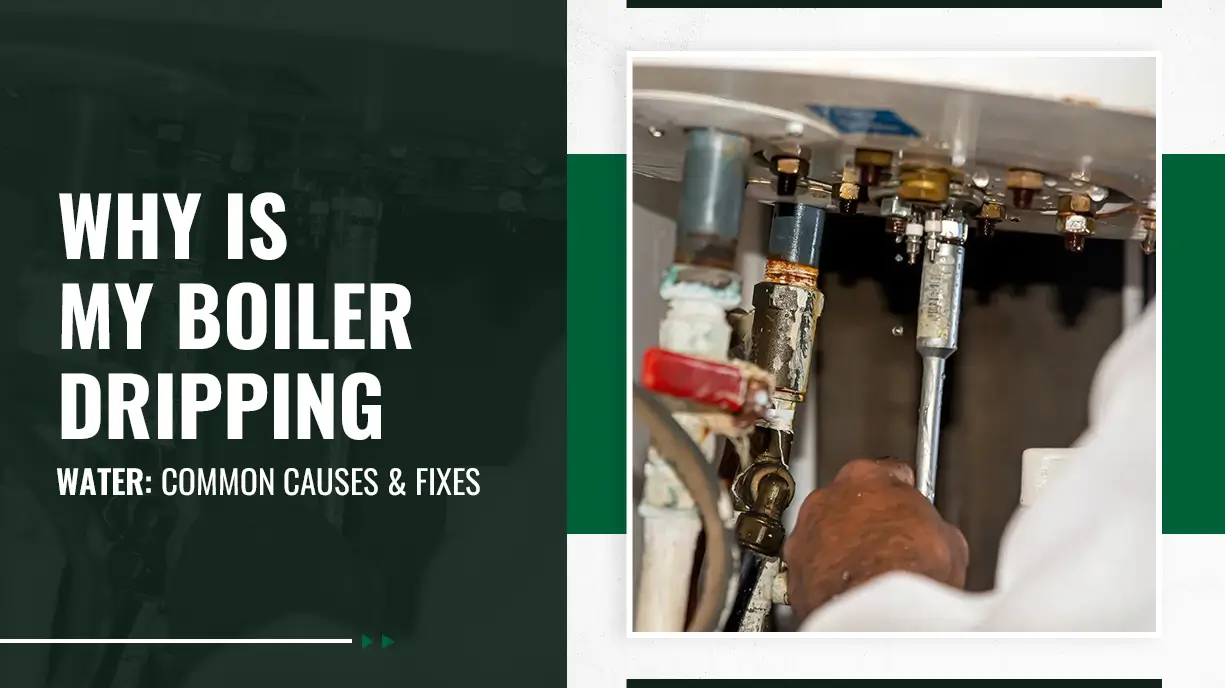
Finding water beneath your boiler can be worrying, even when it appears to be only a small drip. A leaking boiler is not considered normal and should not be ignored. The problem may be as simple as a loose connection, but it could also indicate excessive system pressure, corrosion or a failing internal component.
Water can also reach electrical parts, damage floors and walls, or cause the heating system to lose pressure. Boiler manufacturers therefore recommend arranging an inspection promptly rather than attempting to repair the appliance yourself.
Why Is Water Dripping from My Boiler?
The most common reasons for a boiler dripping water include:
- Excessive boiler pressure
- Loose pipework or leaking joints
- A faulty pressure-relief valve
- A damaged expansion vessel
- Corrosion inside the boiler or heating system
- A cracked heat exchanger
- A blocked or damaged condensate pipe
- Worn pump seals or other internal components
- An incorrectly closed filling loop
- Leaks elsewhere in the central-heating system
The source of the water is not always directly above the visible drip. Water can travel along pipes or internal components before appearing beneath the boiler, so professional diagnosis is usually required.
Is a Dripping Boiler Dangerous?
A small water leak does not automatically mean there is a gas leak. However, it can still create several risks.
A leaking boiler may:
- Allow water to reach electrical components
- Cause the boiler to lose pressure
- Damage the boiler and nearby property
- Create a slip hazard
- Produce hot water capable of causing burns
- Develop into a more serious fault
- Stop supplying heating or hot water
Ideal Heating notes that water inside a working heating system can be hot, while Vaillant warns that leakage may lead to electrical faults and expensive damage.
Do not remove the boiler casing or attempt to repair internal gas, electrical or pressurised components yourself.
1. Boiler Pressure Is Too High
High pressure is one of the most common causes of water leaking from a boiler.
As water heats, it expands and increases the pressure within a sealed heating system. The expansion vessel should accommodate this change. If the system pressure becomes excessive, the pressure-relief valve may open and release water to protect the boiler.
Signs of excessive pressure may include:
- The pressure gauge entering the high or red area
- Pressure rising significantly when the heating is switched on
- Water dripping from an external discharge pipe
- The boiler repeatedly losing pressure after releasing water
- Error codes or boiler shutdowns
The correct pressure varies between boiler models, so you should check the manufacturer’s manual rather than relying on a universal figure. Erratic or consistently excessive pressure can indicate a fault that requires an engineer.
Possible Fix
Check the pressure gauge when the system is cool and compare it with the recommended range in the boiler manual.
Do not repeatedly release water or adjust components unless the manufacturer’s instructions specifically describe a safe user procedure. If the pressure keeps rising, arrange an inspection because the expansion vessel, filling loop or another internal component may be faulty.
2. The Filling Loop Has Been Left Open
The filling loop allows water from the mains supply to enter a sealed central-heating system when the pressure needs topping up.
If the filling-loop valves are not completely closed after repressurising, additional water may continue entering the heating system. This can cause the pressure to rise and may result in water being released through the pressure-relief valve.
Possible Fix
Visually check whether the filling-loop valves are in the closed position, following the instructions for your boiler model.
Do not force a stiff or damaged valve. If you are uncertain about the correct position, or if the pressure continues to increase after closing the loop, contact a qualified engineer.
3. Faulty Pressure-Relief Valve
The pressure-relief valve, sometimes called a PRV, is a safety component that releases water when the system pressure becomes too high.
A temporary discharge may occur because the system has been overfilled. However, the valve may continue dripping if:
- Dirt or debris prevents it from sealing
- The valve has become worn
- High pressure has damaged the valve
- The expansion vessel is not operating correctly
- The valve has opened repeatedly
A common warning sign is water dripping from a copper discharge pipe that runs from the boiler to the outside wall. Worcester Bosch states that a wet or dripping external pressure-relief pipe may indicate a faulty valve.
Possible Fix
The underlying cause must be identified before the valve is repaired or replaced. This normally requires a heating engineer because the valve forms part of the boiler’s pressurised safety system.
4. Damaged Expansion Vessel
The expansion vessel contains a diaphragm and an air or gas charge that accommodates the expansion of heated water.
If the diaphragm fails or the vessel loses its charge, pressure can rise sharply when the heating is on. The pressure-relief valve may then release water. Once the system cools, the pressure may fall too low.
Common symptoms include:
- Normal pressure when the system is cold
- A sharp pressure increase when the heating starts
- Water dripping from the external discharge pipe
- Very low pressure after the boiler cools
- Frequent need to repressurise the boiler
Expansion vessels can fail because of diaphragm deterioration, corrosion or loss of pressure through the charging valve.
Possible Fix
Testing, recharging or replacing an expansion vessel should be completed by a competent heating professional. It may involve accessing the boiler’s internal components and depressurising the heating system.
5. Loose Pipe Connections or Joints
Heating systems expand and contract as their temperature changes. Over time, this movement may loosen a connection or expose a worn seal.
Water may appear around:
- Pipe connections beneath the boiler
- Isolation valves
- Compression joints
- Radiator valves
- The filling loop
- Nearby heating pipes
A small amount of moisture around one joint can gradually develop into a continuous leak.
Possible Fix
You can visually inspect accessible pipework without removing the boiler casing. Dry the visible area and use a piece of tissue to help identify where fresh moisture appears.
Do not tighten boiler connections unless you are qualified and understand the system. Excessive tightening can damage a seal, valve or pipe and make the leak worse.
6. Corrosion Inside the Boiler or Heating System
Metal components can corrode as they age, particularly when the system water has not been correctly treated or maintained.
Corrosion may affect:
- Copper pipework
- Steel radiators
- Valves
- Heat exchangers
- Boiler connections
- Internal components
Possible signs include:
- Brown, orange or discoloured water
- Rust around a connection
- Damp patches on pipework
- Repeated pressure loss
- Several small leaks around the system
- Cold areas on radiators caused by sludge
Possible Fix
A minor corroded section may sometimes be replaced. Widespread corrosion may require more extensive repair, system cleaning or replacement of the affected appliance.
The engineer may also assess the quality of the system water and whether corrosion inhibitor is required.
7. Cracked or Leaking Heat Exchanger
The heat exchanger transfers heat from the burner to the water circulating through the boiler.
Age, corrosion, overheating or debris can eventually cause it to leak. Water may then drip internally and appear at the bottom of the boiler casing.
A cracked heat exchanger can be expensive to replace. On an older boiler, replacement of the complete appliance may sometimes be more economical than installing a major new component.
Vaillant advises that a constant leak from the bottom of an older boiler may indicate a faulty heat exchanger and that diagnosis should be left to a qualified professional.
Possible Fix
A suspected heat-exchanger leak requires professional inspection. Do not remove the boiler casing to look for the leak yourself.
8. Blocked, Frozen or Damaged Condensate Pipe
Modern condensing boilers produce condensate as part of their normal operation. This liquid should flow through a condensate pipe to a suitable drain. The creation and controlled drainage of condensate are normal.
Problems arise when the condensate pipe becomes:
- Blocked by debris
- Frozen during cold weather
- Cracked or disconnected
- Incorrectly installed
- Restricted by poor drainage
Water may back up into the boiler, leak near the appliance or cause the boiler to lock out. Gurgling sounds and repeated shutdowns can indicate a blocked condensate pipe.
Possible Fix
Check only the externally visible pipework. During freezing conditions, an accessible frozen external section may sometimes be thawed using warm—not boiling—water, provided the boiler manufacturer’s instructions allow it.
Do not attempt to dismantle the condensate trap or internal pipework. Call an engineer when the pipe is damaged, inaccessible or continues to block.
9. Worn Pump Seal or Internal Valve
The circulation pump moves heated water through the boiler and central-heating system. Its seals can deteriorate over time, allowing water to escape.
Other internal valves, automatic air vents and seals may also begin leaking because of:
- Normal wear
- Excessive pressure
- Corrosion
- Poor water quality
- Incorrect installation
- Prolonged overheating
Possible Fix
Internal components should be inspected and replaced by a qualified engineer. Continued operation may allow water to reach other parts and increase the repair cost.
10. Leak Elsewhere in the Heating System
The apparent boiler problem may originate elsewhere. A leaking radiator, valve or concealed heating pipe can reduce the system pressure and cause repeated boiler problems.
Check accessible areas for:
- Dampness around radiator valves
- Stains beneath radiators
- Wet pipe joints
- Damp ceilings or floors
- Corrosion around towel rails
- Water near underfloor-heating manifolds
- Dripping from external discharge pipes
Worcester Bosch recommends checking visible joints, radiator valves and connections when a system repeatedly loses pressure. Hidden or underfloor pipework may also need to be considered.
Possible Fix
A visible leak may require a valve, seal or pipe repair. Hidden leaks may require specialist detection equipment to locate them without unnecessary damage to walls or floors.
Is Water from the Condensate Pipe Normal?
Water flowing through a correctly installed condensate pipe to a drain is normal for a condensing boiler.
However, the following are not normal:
- Water dripping from the boiler casing
- Water collecting beneath the appliance
- A condensate joint leaking indoors
- Water backing up into the boiler
- A cracked condensate pipe
- Repeated boiler lockouts
- Persistent gurgling from the condensate system
A white vapour plume from the external flue can also be normal, particularly in cold weather. It is produced as cooler flue gases condense and should not be confused with water leaking from the appliance.
What Should You Do When Your Boiler Is Dripping?
1. Do Not Remove the Casing
The boiler casing protects gas, combustion, electrical and pressurised components. Opening it may be dangerous and can invalidate the manufacturer’s guarantee.
Gas boiler repairs should be completed by a suitably qualified Gas Safe registered engineer.
2. Switch the Boiler Off If Safe
Use the normal user controls to switch the boiler off if water is actively leaking or approaching electrical components.
Do not touch wet electrical switches, plugs or wiring. If it is unsafe to reach the controls, move away and obtain professional assistance.
3. Protect the Surrounding Area
Where it is safe to do so:
- Place a container beneath the drip
- Use towels to protect the floor
- Move belongings away from the leak
- Keep children and pets away
- Avoid touching hot water or pipework
These actions only limit property damage; they do not fix the fault.
4. Check the Pressure Gauge
Record the pressure when the boiler is cold and whether it rises when the heating is operating. This information can help the engineer diagnose the problem.
Do not repeatedly repressurise a boiler that is leaking. Continually adding fresh water can conceal the fault and may contribute to corrosion.
5. Note Where the Water Appears
Without opening the casing, check whether the water is coming from:
- A pipe beneath the boiler
- A visible valve
- The condensate pipe
- The boiler casing
- An external discharge pipe
- A radiator or nearby connection
A photograph may help the engineer understand the problem before attending.
6. Call a Qualified Engineer
Even a slow drip should be inspected promptly. Gas Safe Register provides an official service for finding a registered business and checking an engineer’s current registration and qualifications.
Can You Continue Using a Leaking Boiler?
It is generally safer to switch the boiler off and obtain professional advice, particularly when:
- Water is entering the casing
- The leak is increasing
- Electrical parts are wet
- The pressure is unusually high
- The boiler repeatedly shuts down
- Hot water is escaping
- There are unusual noises or smells
- The leak cannot be clearly located
Continuing to run the appliance may worsen the fault and increase water or electrical damage.
When Is a Boiler Leak an Emergency?
Seek urgent assistance when:
- Water is flowing rather than dripping
- Water is reaching electrical equipment
- The boiler casing is becoming hot or distorted
- Steam is escaping
- The pressure gauge is extremely high
- You hear unusual banging or kettling
- The boiler repeatedly locks out
- You smell gas
- A carbon-monoxide alarm activates
A water leak does not itself prove that gas or carbon monoxide is escaping. However, gas smells and carbon-monoxide warnings must be treated separately as emergencies.
In England, Wales and Scotland, call the National Gas Emergency Helpline on 0800 111 999 if you smell gas or suspect a gas emergency. In Northern Ireland, the emergency number is 0800 002 001.
Why Does My Boiler Leak Only When the Heating Is On?
A leak that appears only when the system heats up often points to a pressure-related problem.
Possible causes include:
- A failed expansion vessel
- Excessive system pressure
- A leaking pressure-relief valve
- A joint that opens as pipework expands
- A crack that becomes visible at higher temperatures
Record the cold pressure and its highest reading while the heating is operating, then provide this information to the engineer.
Why Is My Boiler Dripping After I Repressurised It?
The system may have been overfilled, or the filling loop may not be fully closed.
Excessive pressure can cause the pressure-relief valve to discharge water. The valve may then continue leaking if debris prevents it from resealing properly.
Check the boiler manual and filling-loop valve positions. Contact an engineer if the pressure remains high or water continues to escape.
Why Is My Boiler Dripping from the Bottom?
Water dripping from the bottom of the casing may be caused by:
- A leaking internal connection
- A worn pump seal
- A faulty valve
- A damaged condensate component
- Corrosion
- A cracked heat exchanger
Because the source is probably inside the appliance, do not remove the casing. Switch the boiler off if safe and arrange a professional inspection.
Why Is the Outside Boiler Pipe Dripping?
First identify which external pipe is dripping.
A condensate pipe can discharge water normally into a drain while the boiler operates. A pressure-relief discharge pipe, however, should not continuously release water.
Persistent dripping from the pressure-relief pipe may indicate:
- Excessive pressure
- An overfilled system
- A faulty expansion vessel
- A worn pressure-relief valve
- A filling loop that has been left open
A heating engineer should diagnose the reason rather than simply replacing the valve without addressing the underlying fault.
How Much Does a Leaking-Boiler Repair Cost?
Repair costs depend on:
- The cause of the leak
- Boiler make and model
- Availability of replacement parts
- Age and general condition of the boiler
- Whether the leak has damaged other components
- Labour and call-out charges
- Whether the boiler remains under guarantee
Tightening or replacing an accessible seal may be relatively straightforward. A new pump, expansion vessel or heat exchanger will normally cost more.
Request a written quotation before major work begins. On an older appliance with several faults, compare the repair cost with the cost and expected benefits of replacement.
Can Regular Servicing Prevent Boiler Leaks?
Annual servicing cannot prevent every unexpected failure, but it can help identify deterioration, corrosion, pressure problems and worn components before they become more serious.
Manufacturers commonly recommend servicing a boiler every 12 months to support its safety, condition and efficiency.
Good maintenance should also include:
- Keeping boiler vents and surrounding areas clear
- Checking visible pipework periodically
- Monitoring unusual pressure changes
- Repairing radiator leaks promptly
- Using suitable system-water treatment
- Protecting external condensate pipes from freezing
- Following the manufacturer’s operating instructions
Advice for Tenants
If you are renting and notice water dripping from the boiler:
- Switch the appliance off if it is safe.
- Protect the surrounding area from water damage.
- Photograph the leak and pressure gauge.
- Report the problem to your landlord or managing agent immediately.
- Do not arrange unauthorised repairs unless your tenancy procedure allows it.
- Do not open the boiler casing or attempt a DIY repair.
Make clear whether the property has lost heating or hot water and whether water is reaching electrical equipment.
Frequently Asked Questions
Is a small boiler drip normal?
No. Water draining correctly through the condensate system is normal, but water dripping from the casing, valves or heating connections should be investigated.
Can I fix a leaking boiler myself?
You can carry out basic visual checks and follow safe user instructions in the boiler manual. Internal repairs, removal of the casing and work on gas components must be left to a properly qualified professional.
Will turning the boiler off stop the leak?
It may reduce a temperature- or pressure-related leak, but water can continue escaping from the heating system after the appliance is switched off. Turning it off does not repair the fault.
Why does my boiler pressure keep dropping?
Common reasons include leaking radiator valves, pipework leaks, a faulty pressure-relief valve or an internal boiler fault. Low pressure may result in no heating or hot water.
Should I keep topping up the pressure?
Not repeatedly. If the pressure continues to fall, water is probably escaping or a component is faulty. Repressurising the system again and again does not address the cause.
Can a leaking boiler cause carbon monoxide?
A water leak does not necessarily mean that carbon monoxide is present. However, unsafe combustion faults can produce carbon monoxide, which cannot be seen, smelled or tasted. A carbon-monoxide alarm or suspected gas-appliance fault requires immediate action and professional investigation.
Final Thoughts
A dripping boiler may be caused by excessive pressure, a loose joint, corrosion, a faulty valve, a damaged expansion vessel, condensate problems or a leaking internal component.
Although some visual checks are safe, a boiler should not be dismantled or repaired by an unqualified person. Switch it off when appropriate, protect the surrounding area and arrange an inspection before a minor drip develops into major water damage or complete boiler failure.
Arrange a Professional Boiler Inspection
Do not ignore water beneath your boiler. Arrange an inspection with a qualified Gas Safe registered engineer to locate the leak, repair the underlying fault and confirm that your heating system is operating safely.