

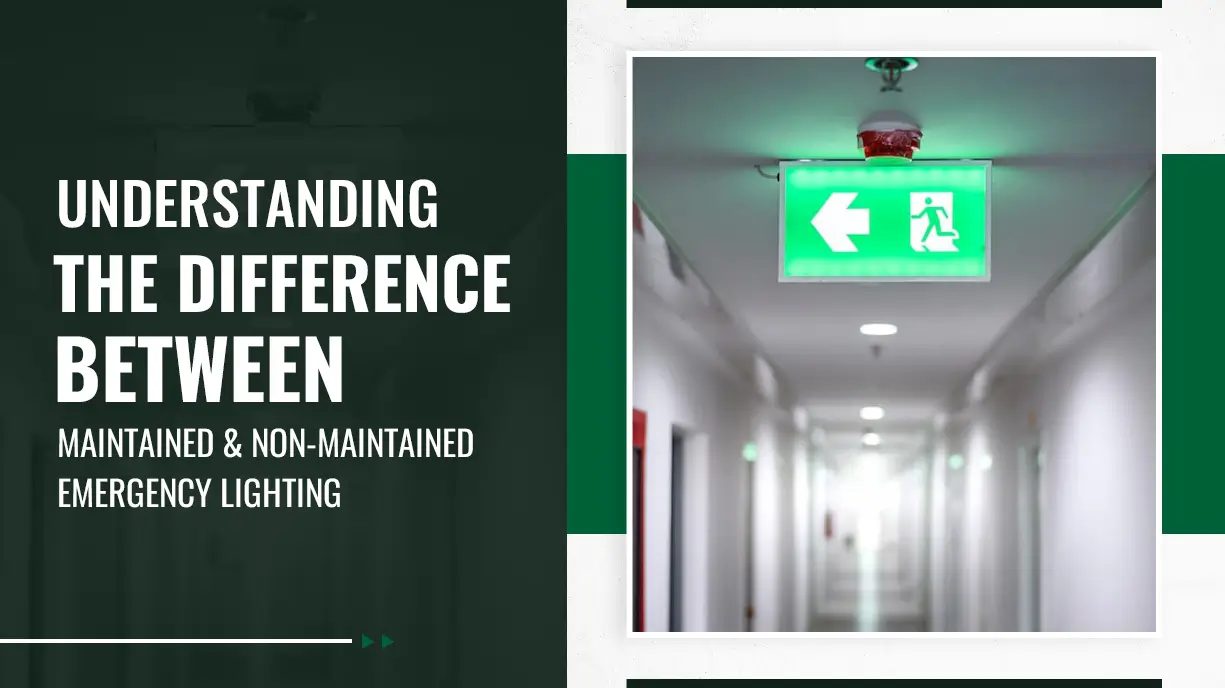
Emergency lighting is an essential safety feature in commercial buildings, residential blocks, offices, rental properties and public spaces. It provides illumination when the normal electrical supply fails, helping occupants find exits and leave the building safely.
However, emergency lighting systems are not all designed to operate in the same way. The two main types are maintained emergency lighting and non-maintained emergency lighting.
Understanding the difference between them helps landlords, property managers and business owners choose the right system for their premises.
What Is Maintained Emergency Lighting?
Maintained emergency lighting remains illuminated during normal building operation. It uses the main electrical supply under normal conditions and automatically switches to battery power if the mains supply fails.
This means the light fitting works as both regular lighting and emergency lighting.
Maintained emergency lights are commonly installed in places where lighting is required at all times, including:
- Cinemas and theatres
- Shopping centres
- Restaurants and bars
- Hotels
- Entertainment venues
- Public buildings
- Areas with limited natural light
For example, an illuminated exit sign positioned above a doorway may remain switched on throughout the day. During a power failure, its internal battery continues to power the sign so occupants can still identify the escape route.
What Is Non-Maintained Emergency Lighting?
Non-maintained emergency lighting normally remains switched off while the building’s regular lighting system is working.
It only activates when the main electrical supply fails.
These fittings contain rechargeable batteries that are continuously charged through the mains supply. When a power cut or electrical fault occurs, the emergency fitting automatically switches on and provides temporary illumination.
Non-maintained emergency lighting is commonly used in:
- Offices
- Warehouses
- Residential communal areas
- Apartment buildings
- Schools
- Healthcare premises
- Commercial units
- Workplaces normally occupied during daylight or under standard lighting
This type of emergency lighting is often suitable where there is no need for the emergency fitting to remain illuminated during normal conditions.
The Main Difference
The main difference is when the emergency light operates.
Maintained emergency lighting stays illuminated during normal use and continues operating during a power failure.
Non-maintained emergency lighting remains off during normal use and switches on only when the mains electricity fails.
Both systems perform the same essential emergency function, but their normal operating behaviour is different.
Maintained vs Non-Maintained Emergency Lighting
| Feature | Maintained Lighting | Non-Maintained Lighting |
|---|---|---|
| Operates during normal conditions | Yes | No |
| Activates during a power failure | Yes | Yes |
| Can be used as everyday lighting | Yes | No |
| Commonly used for exit signs | Yes | Sometimes |
| Suitable for entertainment venues | Often | Less common |
| Battery backup required | Yes | Yes |
Can Emergency Lights Be Switched Between Both Modes?
Some modern emergency light fittings are configurable and can be installed as either maintained or non-maintained units.
These are sometimes described as switchable maintained fittings. They provide greater flexibility because the operating mode can be selected according to the building’s layout and safety requirements.
However, any changes to an emergency lighting system should be carried out by a qualified professional. Incorrect installation or configuration could prevent the system from operating correctly during an emergency.
Which Type of Emergency Lighting Does Your Property Need?
The correct type depends on several factors, including:
- The building’s purpose
- Occupancy levels
- Operating hours
- Availability of natural light
- Layout of escape routes
- Fire risk assessment findings
- Whether the premises are open to the public
- The location of stairs, corridors and final exits
Maintained lighting may be more appropriate in dark public areas or venues where normal lighting is intentionally reduced.
Non-maintained lighting may be sufficient in offices, residential communal areas and other premises where normal lighting provides adequate visibility during everyday use.
In many buildings, a combination of maintained and non-maintained fittings is used.
Why Emergency Lighting Is Important
During a power failure, smoke, darkness and confusion can make evacuation difficult. Emergency lighting helps occupants:
- Identify escape routes
- Locate fire exits
- See stairways and changes in floor level
- Avoid obstacles
- Find fire safety equipment
- Leave the building calmly and safely
Without adequate emergency lighting, even a familiar building can become difficult to navigate.
Emergency Lighting Testing and Maintenance
Installing emergency lighting is only the first step. The system must also be inspected, tested and maintained to confirm that it will operate when required.
Regular checks should confirm that:
- Emergency fittings switch on correctly
- Exit signs are clearly visible
- Batteries hold sufficient charge
- Light fittings are not damaged
- Escape routes receive adequate illumination
- Test results are properly recorded
Any damaged or defective fittings should be repaired or replaced promptly.
Common Emergency Lighting Problems
Emergency lighting systems can become unreliable when they are not maintained correctly. Common problems include:
- Failed batteries
- Damaged light fittings
- Dirty or obstructed exit signs
- Incorrectly positioned lights
- Insufficient illumination along escape routes
- Emergency lights connected to the wrong electrical circuit
- Missing maintenance and testing records
Routine professional inspections can identify these problems before an emergency occurs.
Final Thoughts
Maintained and non-maintained emergency lighting systems both provide essential illumination when the normal electrical supply fails.
Maintained lighting operates continuously, while non-maintained lighting switches on only during a power failure. The right option depends on the building type, occupancy, layout and findings of the fire risk assessment.
A properly designed, installed and maintained emergency lighting system helps protect occupants, supports safe evacuation and improves overall fire safety compliance.